



 74 / 148

Harlequin Grays
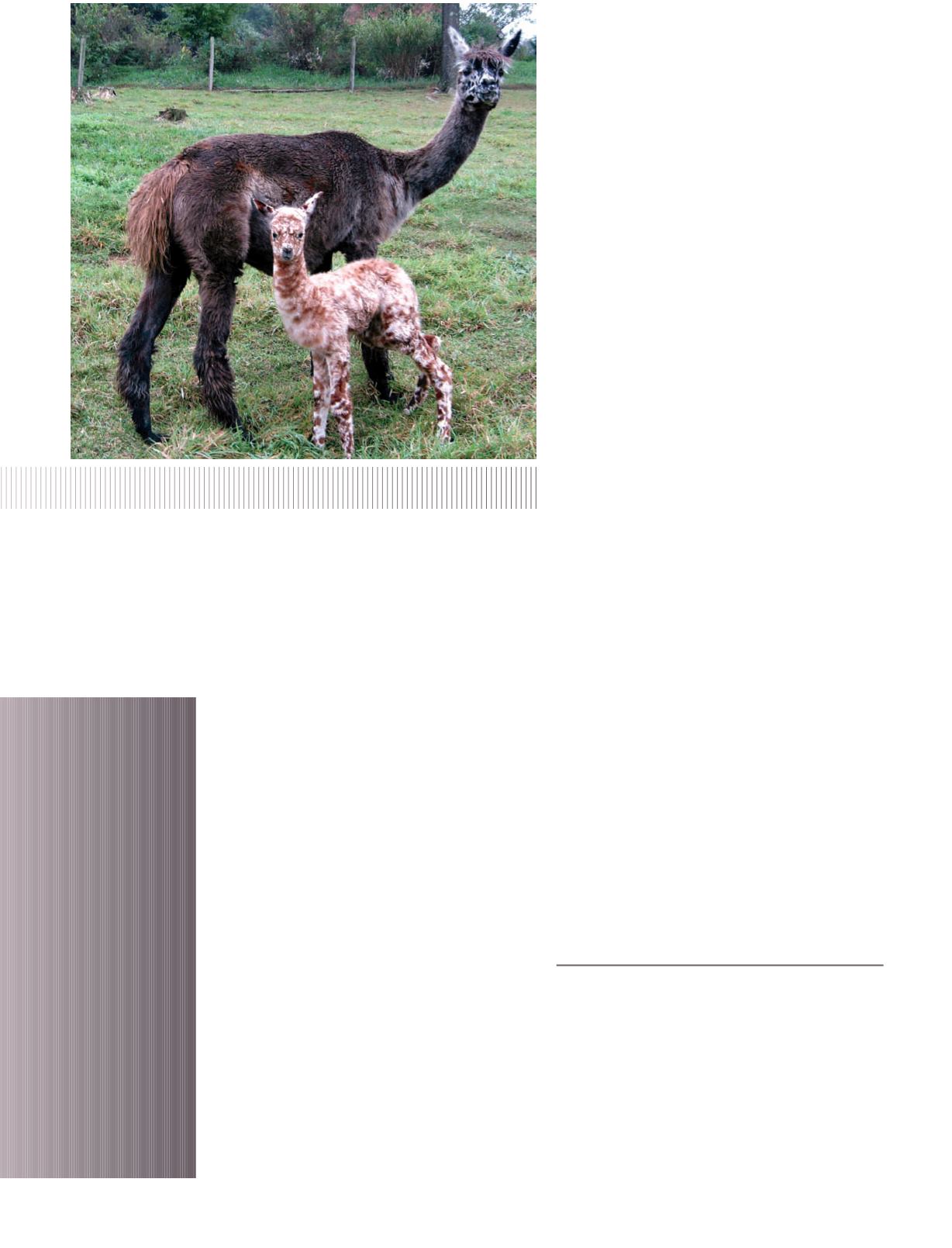
These are grays with dark spots or speckles over the
face and often over the whole body. They do not
typically have any white on them, and are thus not a
risk for making BEWs. Again, this is likely a differ-
ent gene than any of the other kinds of grays. The
inheritance pattern is not clear for harlequin grays.
Harlequins are fairly common in suris, due to the
large influence of Condor and Romantico on the
U.S. suri herd. They have produced many harlequin
grays. It could be dominant or recessive. I am still
investigating these. Right now, the number of crias
from crosses is too low to make any kind of mean-
ingful guess, but hopefully, we will collect enough
breeding data to say dominant or recessive soon.
Indefinite Grays
I am not sure what to call these animals, but they
are the ones which have a uniform color without
white or dark spotting, but white or black fibers
throughout the fleece. I am also not sure of the
inheritance pattern, nor how these relate to indefi-
nite-fleeced animals that are not classified as grays.
More data is needed to sort out the inheritance
pattern(s) of these animals.
How to Breed for Gray
My recommendations for how to breed for a gray
cria depends on which kind of gray you are starting
with and your preferences for silver versus rose gray,
spots or no spots, and white markings or not. For
classic gray, I recommend only breeding to solid
non-whites. You should get 50% gray crias (on aver-
age) from such crosses. While gray to gray breedings
yield 65% gray crias, they also represent a 25%
increased risk of loss due to the lethal gray phenome-
non. Further, you typically get a MUCH bigger
fleece boost breeding gray to fawn than you can get
breeding gray to gray. It does not matter which part-
ner is solid and which is gray. If you only like silver
grays, then breed silver grays to blacks and you
should get 50:50 silver grays and blacks (on average).
If dark-head roan gray is a simple recessive gene,
then dark-headed roans bred to the other dark-
headed roans should make dark-headed roan crias
almost all the time. Otherwise, dark-headed roans
should be bred to carriers of the roan allele for a
lower percentage outcome of roans, but possibly a
bigger fleece boost.
For harlequin grays, breeding two together would
seem a good bet, but until we figure out the inheri-
tance pattern of the gene, it is just a guess. The
same holds true for Indefinite Grays.
Help with Research
Good luck. If you wish to help with my research,
please call or send an e-mail to me for more infor-
mation. We are sequencing candidate genes for
color and pattern (Mit-f, Agouti, ASIP, MC1r, and
KIT, among others) and also mapping the genes for
color and pattern using STR loci developed by the
Alpaca Genome Project. You can send blood sam-
ples from your gray crias and the parents that made
them to help with my research. Blood should be
drawn into EDTA vacutainers (purple tops) and
overnight-mailed with a blue-ice pack to:
D. Andrew Merriwether Lab, Dept. of Biology
210 Science III Bldg., Binghamton University
Binghamton NY 13902-6000
Lab phone: (607) 777-6707
E-mail:
andym@binghamton.eduAndy Merriwether, Ph.D. is an Associate Professor of
Anthropology and Biology and Director of Graduate Studies in
the Department of Anthropology at Binghamton University,
State University of New York. He has a B.A in Medical
Anthropology (1988), B.S. in Biology (1988), and an M.S. in
Genetics (1989) from Penn State University, and a Ph.D. in
Human Genetics from the University of Pittsburgh (1993). Andy
and his wife, Ann, own Nyala Farm Alpacas in Vestal, New
York. Andy has been working on the genetics of camelids
since 1997 and can be reached in care of
Alpacas Magazine.
74
Alpacas
Magazine
The Harlequin gene is likely a different gene than any of the other kinds of grays.
The inheritance pattern is not clear for harlequin grays.
© 2009 Ed Kinser
Caveat: As each of
these kinds of grey is
caused by a different
gene, it is possible for
an animal to be more
than one kind of grey.
While rare, this can
arise from breeding
different kinds of
greys together. For
example, an animal
could be both roan
grey and classic grey.
Adding to the confu-
sion, a roan grey
could also get a copy
of a white spot allele
from a parent with
white spot. Neruda
may be like this, as
some have reported
he has a white mark-
ing, but he is clearly
a dark headed roan
phenotype, and has
very rarely made
classic greys unless
bred to them.