



 71 / 148

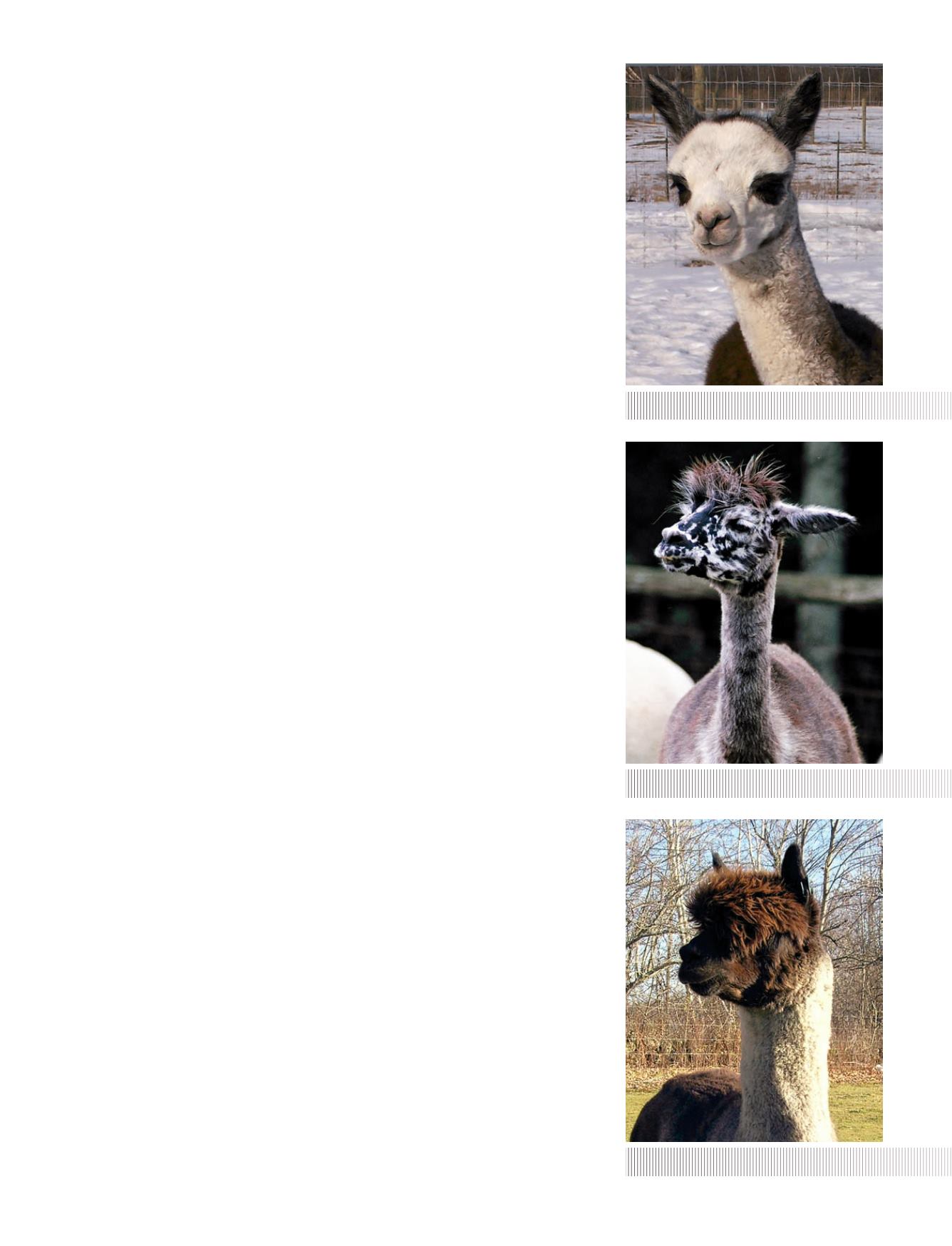
Classic or Tuxedo Gray
Harlequin Gray
Dark-Headed Roan Gray
Classic grays very often have brown or
black spots on their bodies. Silver
Grays and Rose Grays
are both part of this phenotype. This
phenotype is caused by two genes.
The first I call the “White Spot Gene,”
and that is the gene that puts white or
gray on the animal. The second gene
I call the “Base Color Gene,” and it
determines the base color. Silver grays
are black animals at the base color
gene, with two copies of the black allele
(bb), and they have one gray allele of
the white spot gene and one solid allele
of the white spot gene (GS). Think
of it as a black animal that has been
grayed. Rose grays are beige, fawn or
brown animals that have been grayed,
so at the base color gene they are one
of many combinations of alleles that
make beige, fawn, or brown and at that
the white spot locus they have one gray
allele and one solid allele (GS).
Lethal Homozygous Classic Gray
I believe that the gray phenotype
(white at the extremities and gray fleece
everywhere else) is coming from one
dominant allele of the white spot gene.
I also believe, as suggested by Liz Paul,
that two copies of the gray allele of
the white spot gene is lethal, and those
animals with two copies are not born.
Perhaps they would have been blue-
eyed whites if it were not a lethal com-
bination, as all other combinations of
two white spot alleles create blue-eyed
whites. Since classic gray to classic gray
breeding almost never makes blue-eyed
whites, I assume it is lethal. The fact
that there are no herd sires in the ARI
database with large numbers of crias
that have ONLY made grays or whites,
no matter what they are bred to, means
there are no homozygous dominant
grays. There should be many homozy-
gous dominant grays by now if it were
not lethal, as many breeders have bred
gray to gray over the years. They do
not exist, and the only explanation that
is plausible is that homozygous classic
gray is lethal. The growing body of
anecdotal evidence shows that many
get reabsorbed or aborted at or before
five months for those pregnancies that
we know took hold. I suspect most are
lost almost immediately though. The
other evidence for lethal gray is circum-
stantial population genetic data. There
are three scenarios for a breeding
between two gray alpacas:
If two copies of gray makes gray,
then there should be 75% or more
gray offspring from gray to gray
breeding, and some (homozygous)
animals should produce gray no
matter what color they are bred to.
If two copies of gray make a blue-
eyed white, then 25% of gray to gray
breedings should yield BEWs.
If two copies of gray is lethal, then
we are left with 1/4 not born
homozygous grays, 2/4 gray, and
1/4 solid animals (or 66% gray
and 33% solid animals born).
For example: in a mating between
a tuxedo gray female with a solid
tuxedo gray sire:
G = tuxedo gray allele
S = solid allele
GG = ??? [scenario 1 = gray,
scenario 2 = BEW,
scenario 3 = lethal]
Female Gamete
S
G
Male Gamete
S
S/S
S/G
G
G/S
G/G
A partial summary of the ARI database
and a complete tally of the Australian
registry show pretty close to 65% gray
crias when two grays are bred, exactly
as predicted if the lethal gray theory
is correct.
Spring 2010
71
© 2009 Eric Lorrince and Chris Barty
© 2009 Ed Kinser
© 2009 Darlene Reardon