



 70 / 148

W
ith all the discussion about gray alpacas
taking place online on the various alpaca
chat forums, I thought it would be worthwhile to
reiterate my current understanding of the different
kinds of grays and how their phenotypes are passed
on. I would suggest that there are at least four kinds
of alpacas that are called grays.
1. The majority of grays in my database are what
I call “Classic Grays,” also called “Tuxedo Grays”
or “Tux Grays.” I think tuxedo gray is misleading,
as a tuxedo is not required for the phenotype,
just white markings at any of the extremities,
no matter how small.
2. A small percentage of grays have no white
on them, and dark heads and legs. These are
what I call “Dark-Headed Roan Grays.”
3. A small percentage of grays have no white
on them, but have speckles on the face and
often throughout the blanket. I call these
“Harlequin Grays.”
4. Lastly, there are some animals that are gray, with
no white on them, no spots, no dark points, and
these often may end up in the “indefinite” classes.
These are the types I have recognized, and have
been collecting data on, in order to determine the
inheritance patterns of the genes causing these
phenotypes. The data comes from the Alpaca
Registry, Inc (ARI) and Australian Registries. We
looked up pictures of as many animals as possible,
and categorized them into these four types. I have
had students tallying all the outcomes, by sex, from
all the gray males in the ARI database, and trying to
find pictures or descriptions that say whether or not
they have white on them, and if not, which kind of
gray they are likely to be. Liz Paul in Australia has
also tallied all the gray data from the Australian
herd books.
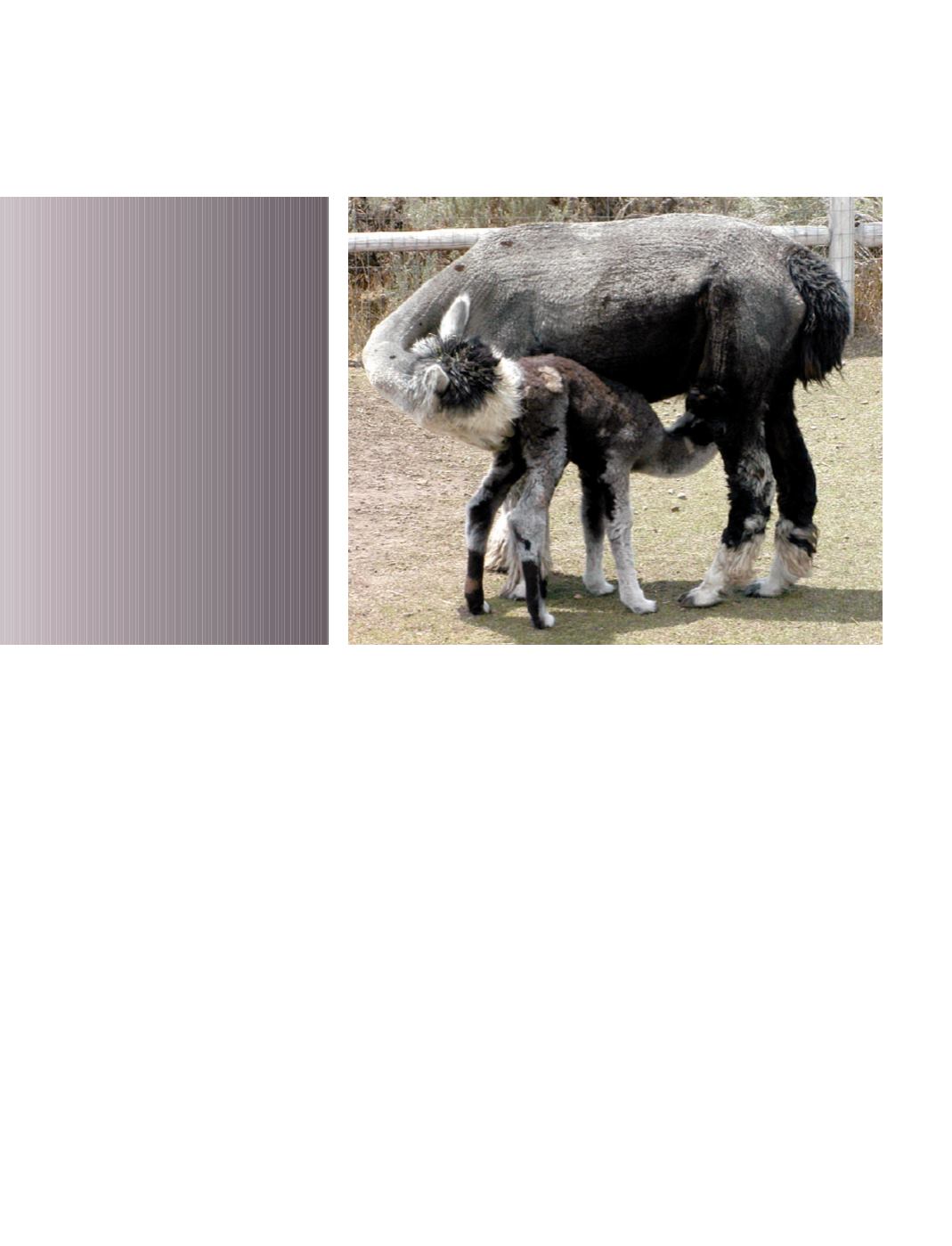
Classic Grays
These are gray animals with white markings at
some or all of the extremities (face, head, neck,
legs, feet, tail, and/or groin). It does not matter
how small the white markings are, so long as they
are at one or more of the extremities. The most
common variant of this is the tuxedo gray, which
has a white face and front of the neck and bib and
white stockings and feet. The back of the topknot
is often much darker than the rest of the animal.
70
Alpacas
Magazine
By D. Andrew Merriwether, Ph.D.,
Associate Professor of Anthropology and Biology
Director of Graduate Studies, Department of Anthropology
Binghamton University
The Genetics
of
Gray
Alpacas
© 2009 Carol Frazer