



 78 / 148

78
Alpacas
Magazine
and started its own experimental alpaca ranch some eleven
years ago. Pacomarca, “The Land of Alpacas,” was born with
the aim of breeding a very select group of the best Peruvian
alpacas, to study them, carry on experiments, and share the
findings and the products obtained with the poorest and
smallest of the Andean breeders.
Pacomarca was initially located on the slopes of the Sabancay
volcano. However, in 1990, when the volcano decided to erupt,
the Sallalli alpaca farm, located at its side, had to be moved in a
hurry. The Inca Group’s initial eight years of work with alpacas
had come to an abrupt end. Every animal of the 800 that were
raised at the farm was either lost, stolen, or got sick. Only eight
of the 23 initial Accoyo males were saved.
It took ten years to get another farm developed and
operating. This time, the location had to be other than at
the foothill of Perú’s most active volcano. During those years,
alpaca breeding had started to pick up outside Perú and the
Australians and Americans were coming up with methods
and systems unknown to Peruvians. The decision was made
to have the new farm, Pacomarca, run in a modern way, with
all the technological gadgets available and with a genetic
program laid out from the beginning. The plan was to create
a state-of-the-art breeding operation, specifically designed
and professionally run to combine the best practices of
6,000 years of domestic alpaca history in Peru with today’s
technology and husbandry practices.
After 50 years of buying alpaca fiber from owners through-
out Perú, Inca Group knew where to select its initial quality
breeding stock with finest fiber. That is exactly where they
went to look for the original stock. Old females were bought,
to the amusement of local peasants, who thought nobody in
his right mind would ever buy an adult alpaca female high
up in the Andes. That would mean at least three or four
years less production! But not if you were looking for those
fine ladies that had kept their low micronage up until six or
seven years of age. The same with the males. Nice grown-up
boys were recruited from the most renowned farms, such
as Alianza, Accoyo, and Sollocota.
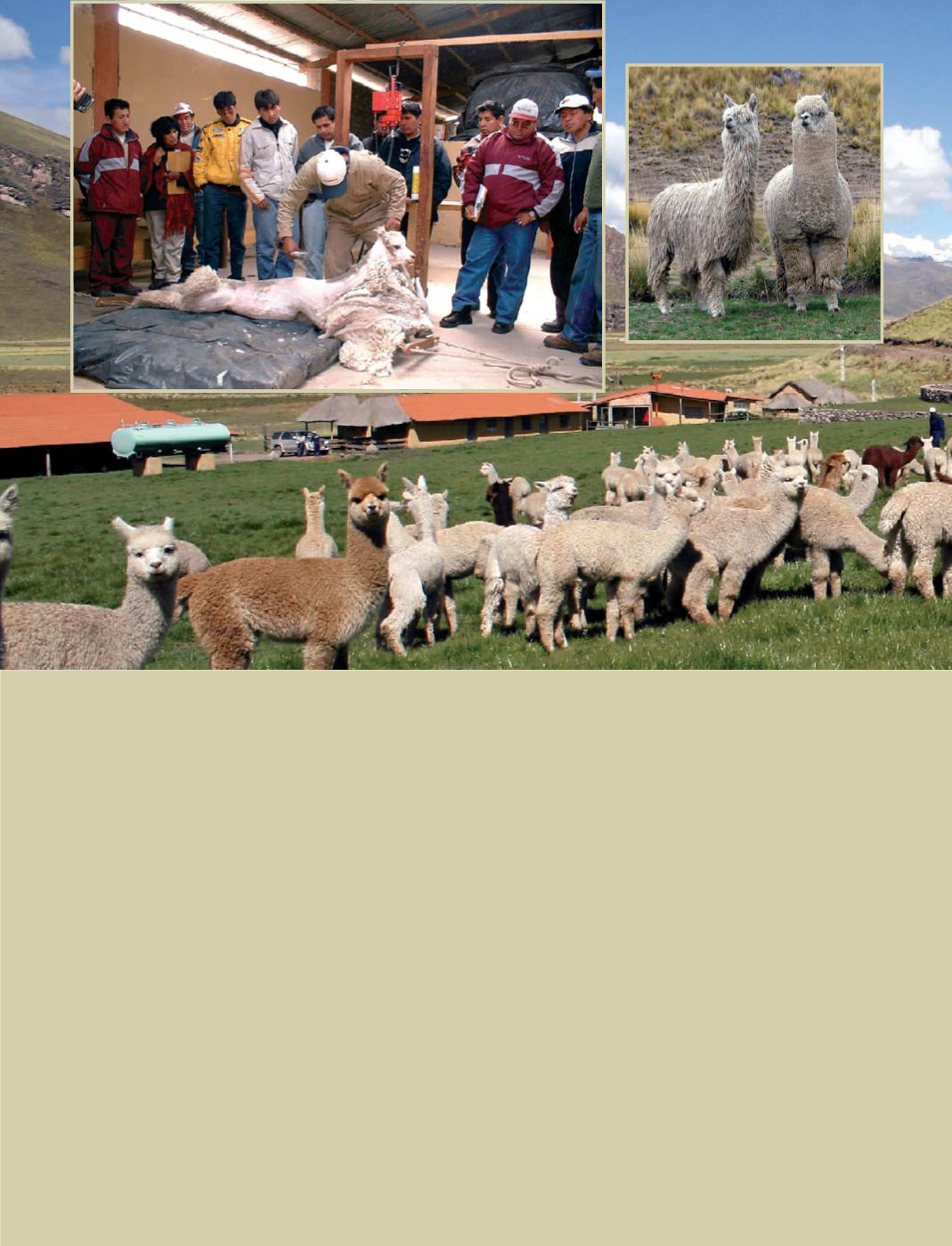
The initial 400 animals were transported to their new
home – hundreds of hectares of natural grass and no fences.
The needed infrastructure was carefully planned and construct-
ed. Another 300 alpacas were added the year after that, and
with them, it became abundantly clear that we needed to
keep as many records as possible, well ordered, easily accessible
and, most important, completely interrelated. That is how
Alfredo, a young Peruvian systems engineer, started working
full time on the PACO PRO
1
system. Nine years later, the
system contains close to two million pieces of data from