



 79 / 148

the Pacomarca animals, thus making it the world’s largest
alpaca database of recorded production records.
With this kind of data at hand, Pacomarca contacted
Dr. Juan Pablo Gutierrez, a well known European geneticist
from the Universidad Complutense de Madrid (Spain) in
order to carry on an analysis from which Estimated Progeny
Differences (EPDs) and heritability predictions could be
drawn. After three years of running the EPD analysis,
Pacomarca now uses the genetic valuation information in
order to run its embryo transfer (ET) program. The 2009
ET program at Pacomarca produced 100 babies from the
highest-valued animals on the farm, with special emphasis on
producing alpacas with fiber characteristics of the Royal Lines.
In the mean time, Pacomarca runs a unique training
program for alpaca breeders from all over the country. Over
1,000 Andean breeders benefit from courses, field days, and
demonstrations organized by the company throughout the
year. For most of the small-time alpaca herders, a visit to
the Pacomarca ranch is something out of this world, with
the ultrasound pregnancy test being the very highlight of the
day. However, even though the Pacomarca general operation
seems strange and foreign for most alpaca herders, some
practices like the one-to-one mating (controlled pen breeding
versus traditional, random pasture breeding) have already
been copied by many owners in the high Andes.
Furthermore, after learning new shearing techniques
developed by Pacomarca, many owners adopt the new
procedures in their next shearing. By selling the fiber to
Grupo Inca’s processor, Inca Tops, they gain not only the
best market price, but also a bonus which can be exchanged
for any of the products or services that Pacomarca provides:
studs, stud services, pregnant females, technical courses, etc.
The program has worked out beautifully for both sides.
The Pacomarca experimental ranch is now considered
to be the leading genetic improvement center in Perú and
its influence in the alpaca breeding and scientific world
is proving to be essential for the future of this precious
resource in its native country.
1. PACO PRO is an alpaca management tool which utilizes search tools
for tracking the animals at Pacomarca. We can identify and explore a
specific animal, its relatives, and its entire genealogical tree. In addition,
the system tracks animal attributes, fineness statistics, and production
records like fleece weight or staple length. Data stored in the software
allows us to pinpoint relevant information about a single animal and this
in turn helps us to identify the most elite animals. Furthermore, PACO
PRO makes it easy to plan individual matings based on the EPD
(Expected Progeny Difference) of each animal.
Spring 2010
79
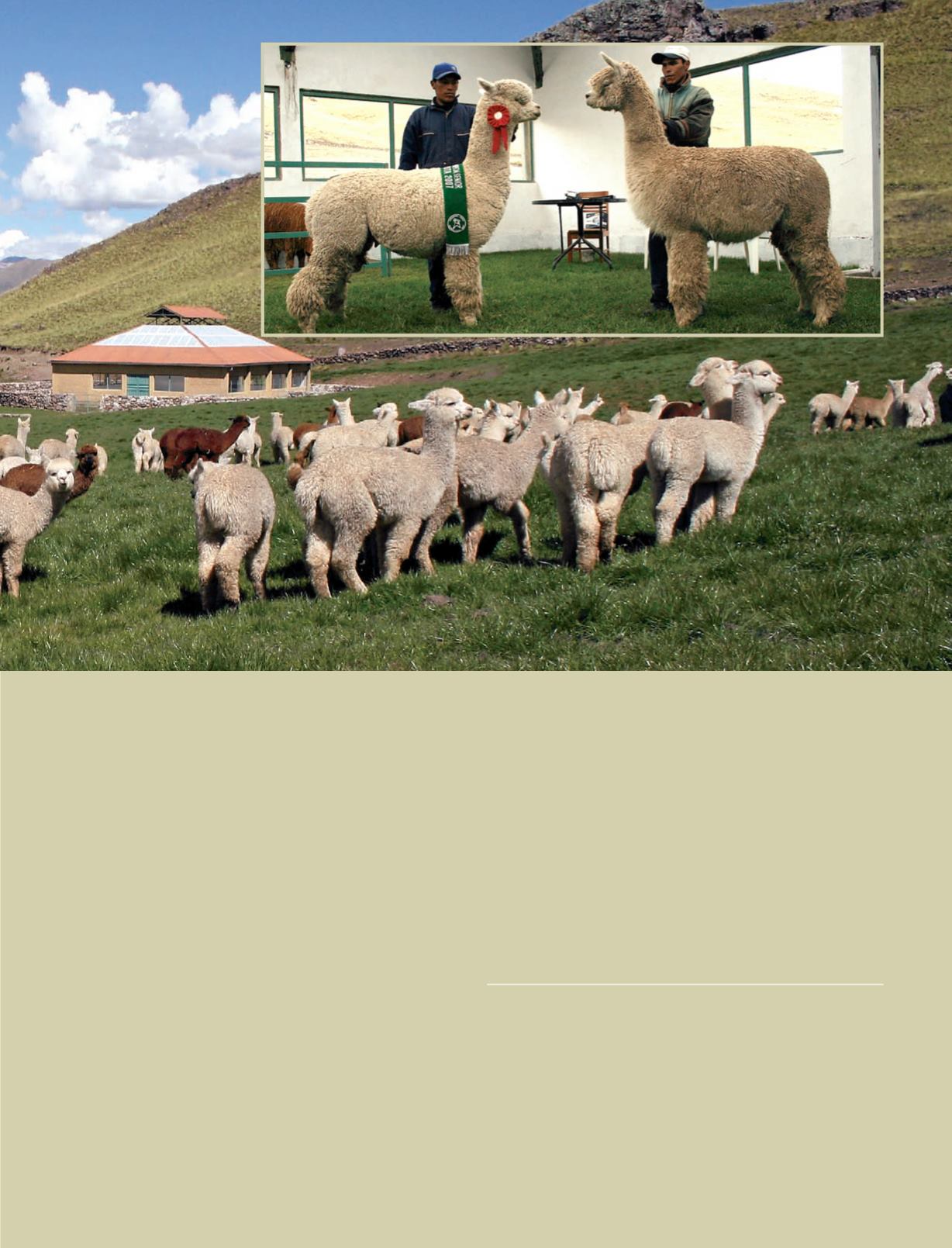
Photos courtesy of the authors.