




 84 / 148

In 1890, Congress passed the Sherman
Antitrust Act. Every agreement, combi-
nation, or conspiracy in restraint of
trade or commerce was declared illegal.
Competing industrialists could no
longer lessen their competition. Two
of the most well known monopoly
breakups came in 1911. In that year,
the U.S. Supreme Court ordered the
dissolution of Standard Oil Company
and American Tobacco Company.
In its zeal to restore industrial com-
petition, the Court failed to consider
the needs of farmers. Farmers had long
worked together in cooperative associa-
tions for financial survival. They feared
their cooperatives would be targeted
by law enforcers and struck down by
courts under these antitrust laws.
This fear was strengthened by a 1908
Supreme Court decision comment
interpreted by many to prohibit the
joint pricing and marketing of farmer
cooperatives. In fact, farmers were
prosecuted for price-fixing in several
states under statutes similar to the
Sherman Antitrust Act.
Cooperatives allowed farmers to
eliminate competition among them.
They were farmers working together to
market their agricultural commodities.
This was the very concept the early
American industrialists used to survive.
But it was the industrialists, not the
farmers, who abused their position,
causing Congress to act in 1890.
Farmers made a lot of noise! The
Clayton Act of 1914 gave some relief.
But it was not until the Capper-Volstead
Act of 1922 that farmers were specifically
exempted from the restraint of trade
limitations of the antitrust laws. The
Capper-Volstead Act and the five
Supreme Court decisions interpreting
the Act mandated specific business
operating requirements for permissable
farmer joint activity. The cooperative
business model is the manifestation of
these operating requirements.
84
Alpacas
Magazine
WISH TO MAXIMIZE YOUR FIBER INCOME?
Consider joining the Alpaca Fiber Cooperative of
North America, Inc. It is a cooperative corporation
formed in 1998
under the laws of
the State of
Colorado. AFCNA
was crafted to
comply with all the
cooperative legal
and tax mandates
discussed above.
It allows all alpaca
farmers to easily
benefit from the
cooperative business
model. AFCNA has designed an infrastructure for
a national large volume fiber industry. It will only
maximize your fiber income if you get behind the
momentum AFCNA
is building.
Becoming a coop
member is easy:
Just click on “Join
AFCNA” in the left
menu at: afcna.com.
Remember: every
alpaca farmer wins
with a cooperative.
Maximize by Joining!
Join the over 1,600 current
AFCNA alpaca farm
member owners to build
a fiber industry benefiting
all alpaca farmers.
Fleeces contributed
to the Alpaca Fiber
Cooperative of North
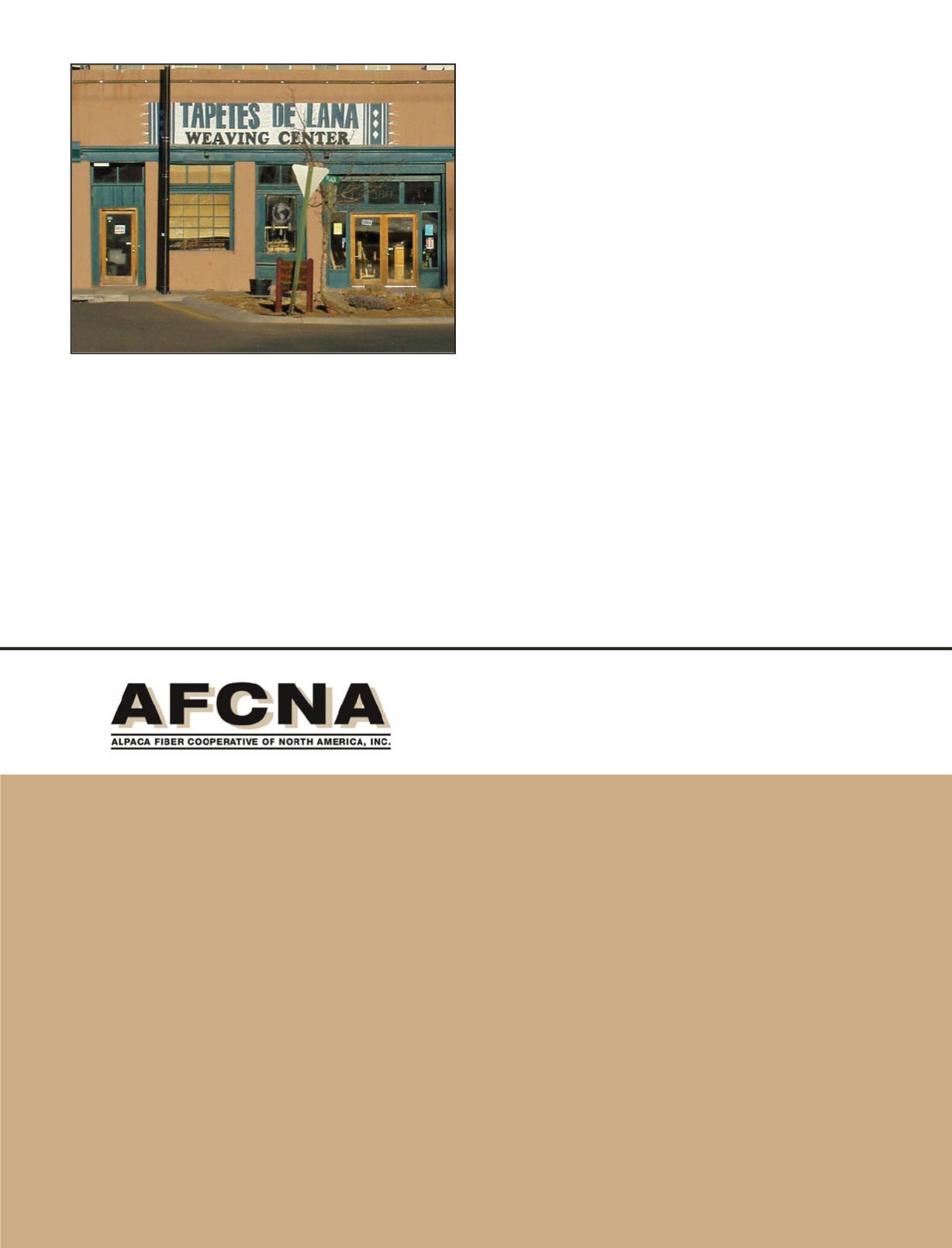
America are sorted at
this Tapetes de Lana
facility in New Mexico.