




 44 / 148

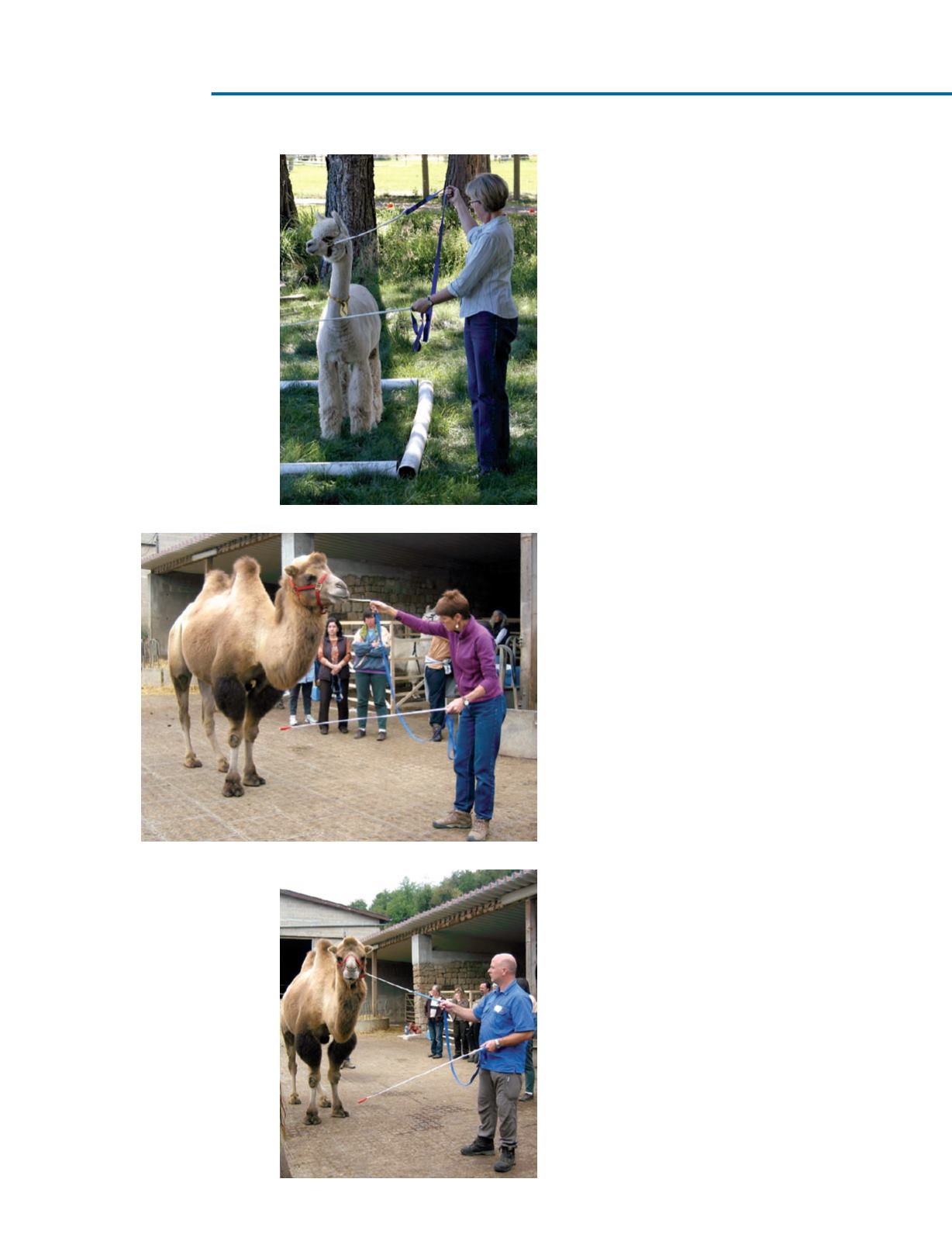
I like to stop before each obstacle, use that moment
to ask my alpaca to stand in balance, then proceed
slowly and deliberately, one step at a time. This
teaches the alpaca to wait and listen, instead of
anticipating you.
The essence of leading with precision is to be
connected to your alpaca through the lead rope and
using it to have a conversation. Speaking to your
alpaca with the lead rope is very much like talking
on the telephone. Once the connection is estab-
lished through the lead line, the process involves
speaking and then waiting and listening.
People who don’t stop talking and don’t listen to
feedback from other people end up being ignored.
The same is true with alpacas. Look at the photos
of the camel. These photos illustrate a connection
and lack of connection through the lead. A lead
that is too tight or too loose will compromise the
connection. A loose lead does not transmit signals,
leaving the animal to make up his own agenda and
a lead that is too tight encourages the animal to use
the lead for balance. The trick is to be able to move
around and maintain this light connection at the
same time. You will notice in most of the photos,
the handler is carrying a white wand. This tool is
very helpful for helping to maintain contact by
helping you keep the alpaca slightly away from
you, as well as helping to slow an animal down
and teach a balanced halt.
Stopping together in balance with your alpaca
is key to beautiful leading and successful showing.
A balanced halt means that the handler and animal
slow down and stop in unison. Too often, the han-
dler thinks halt and stops immediately before the
animal “hears” the command and processes its
meaning. This sets the stage for circling. Circling
is distracting for the animal and the judge. A
balanced halt is achieved by giving an up-and-back
signal to halt and slowing down, BUT continuing
to walk until the animal slows and stops with you.
Refined leading with precision is about imparting
information through the lead, but it is also about
using your body and body position to communi-
cate, as well. Your alpaca is highly aware of your
body language. Your alpaca knows when you hold
your breath, and interprets this as danger. This
explains why your alpaca might be standing quietly
44
Alpacas
Magazine
CAMELIDynamics
In this photo the handler has just
asked for a balanced halt. Note
the nice light connection through
the line and the use of the wand
as a secondary signal.
Okay, okay… I know these are
not alpacas, but camels are so
expressive and the photos speak
volumes. In the photo above, I am
using light contact with this camel
to teach him to take one step at
a time – an exercise that we call
“The Dance.” Look at his face. He
is interested and engaged. In the
next photo, a student is trying the
same exercise with the same camel.
Consistent with being a beginner,
this handler is a bit heavy-handed
and is using steady pressure.
The Bactrian responds with a
look of consternation!