




 43 / 148

Spring 2010
43
Photos courtesy of Marty McGee Bennett
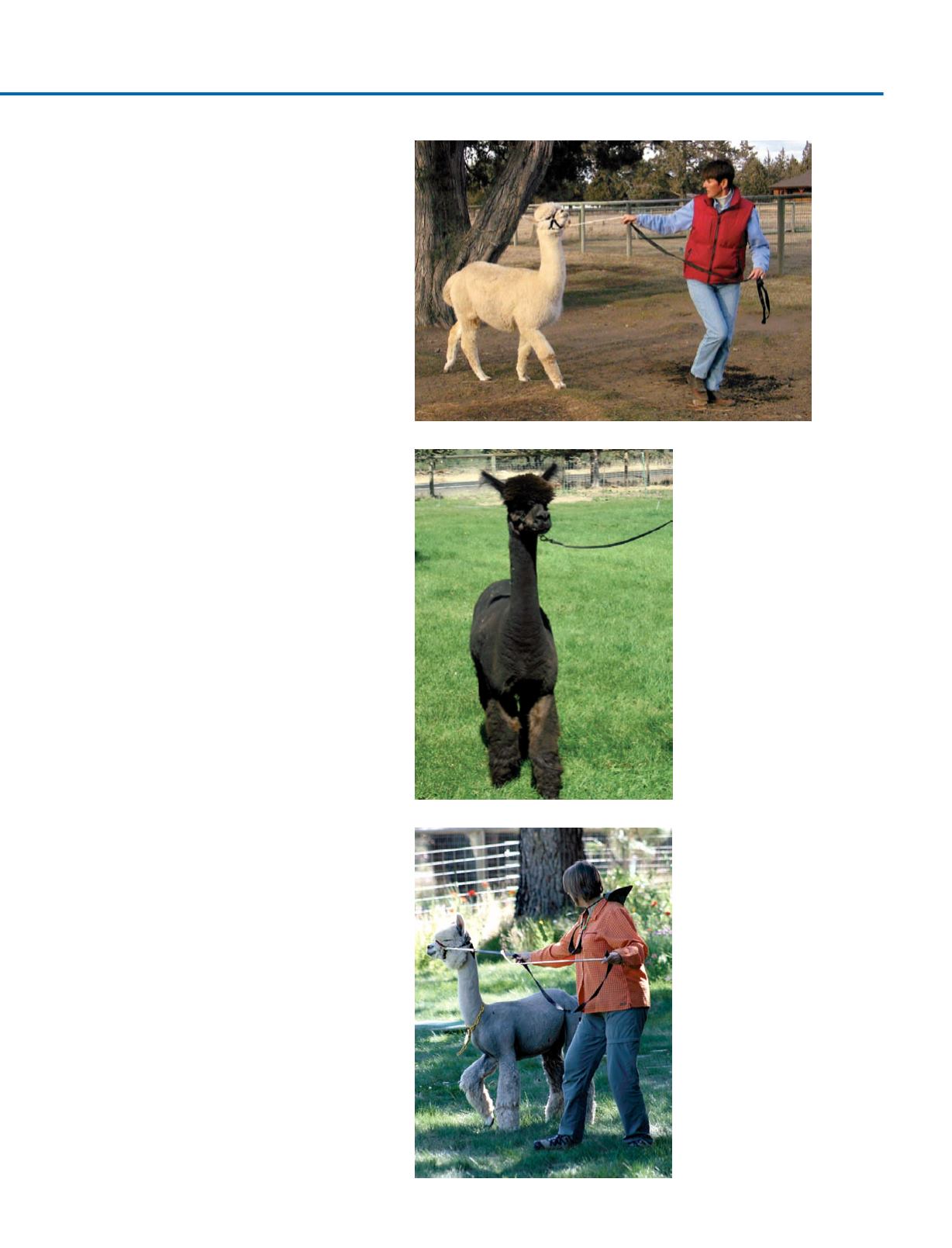
Top, I am pulling on the lead.
You can see the result is that
the alpaca pulls back, throwing
its weight to the rear, dropping
the back and raising the head.
It would be very difficult for
a judge to see much of anything
about an animal led this way.
This alpaca is standing in balance.
Her head is lined up with her neck;
her neck is lined up with body; and
her body is over her feet.
In this photo, the handler has steady
pressure on the lead. As a result, the
alpaca is using the lead for balance
and is leaning to the side.
Make sure your alpaca’s halter fits safely and com-
fortably (see the SUM96 and HER07 issues of
Alpacas Magazine).
Without a properly fitting
halter, your attempts to truly communicate with
your alpaca will be impossible. The halter will not
work to communicate your signals. Additionally,
the ill-fitting halter will distract the alpaca.
Use a longer lead rope for your training sessions
(6-7 feet). Alpacas are frightened when they
leave their pals and head out with you. Handlers
mistakenly think that bringing the alpaca up
close helps! I have news for you… you are part
of what they are frightened of! A longer lead
gives your alpaca room to think and get far
enough away from you to ease the pressure your
presence creates. Getting away from your alpaca
also gives him a chance to learn to carry himself
without your interference.
If your halter has a ring on the NOSE BAND
you can try leading from this ring
(see photo
on page 45).
Leading from the side ring is like
having power steering. This technique makes it
easier for the alpaca to understand the signals
you give and much easier to maintain contact.
You must use this technique as described with
the kind of halter that supports the technique.
Leading from the cheek ring will not work!
Once your alpaca is performing well, you
can switch back to the standard leading ring
under the chin.
Now that you are out and about, connected to your
alpaca with a properly fitting halter and a longer
lead, head out to the “playground for higher learn-
ing.” I have borrowed this wonderful phrase from
my teacher and mentor, Linda Tellington-Jones.
Yep. Set up a few very simple obstacles in your
leading area. I like poles. I use a combination of
wooden fence posts, drain-pipe (six inches in
diameter) and PVC pipe of various lengths. The
obstacles I use are illustrated in the accompanying
photos and captions. You should have some easy
obstacles and some that are more complicated.
The main thing is that these obstacles are used
as an excuse for you to give very precise signals,
NOT as a punch list. Dragging your alpaca over
all of the obstacles DOES NOT constitute success.