




 45 / 148

Spring 2010
45
and rears up just as the judge lifts his head from
the animal next to you, but before he takes even
one step toward you. Your alpaca knows when you
lose focus and are not paying attention. This
explains why he picks this exact moment to sniff
his
neighbor or becomes distracted in the line up.
Your alpaca also mirrors your posture and
attitude. I was doing some demonstrations and
helping exhibitors at a show recently when a tall,
beautiful woman brought her alpaca to me for
help in the ring. She told me, “This alpaca does
brilliantly in the show ring for the person I bought
him from, but he is clumsy and slow and he won’t
hold his head up for me.” I asked this woman to
lead the alpaca for me in the aisle way of the arena.
What I noticed as she led him, was that she
(the woman) was kind of clumsy and slow and
didn’t hold her head up! I asked her to pick her feet
up, stand up straight, and become more animated.
Lo and behold so did the alpaca! She brought him
back later, proudly holding her first place ribbon
and I hardly recognized either one of them as the
downtrodden pair that asked for help earlier in
the day!
Leading with precision shows off your animal
to the judge AND shows off our industry to the
public. Leading with precision in the show ring
looks more interesting and professional to those
observing YOU interact with your animals,
possibly leading to farm visits and sales. Certainly,
leading with precision increases your chances
of success in the show ring. Your animal looks
better, more balanced, and feels safer and is
therefore more likely to stand well for inspection.
And even if you don’t win, you will have had
more fun.
For over 25 years, Marty has traveled the world, devoting
her professional life to the well-being of camelids and the
education of their owners. Her clinics, books, and videos
have helped thousands of camelid owners more fully
understand, appreciate, and enjoy their animals. Marty
and her husband, Brad, operate the Camelidynamics
Training Center in Bend, Oregon. She can be reached
at
marty@camelidynamics.com.
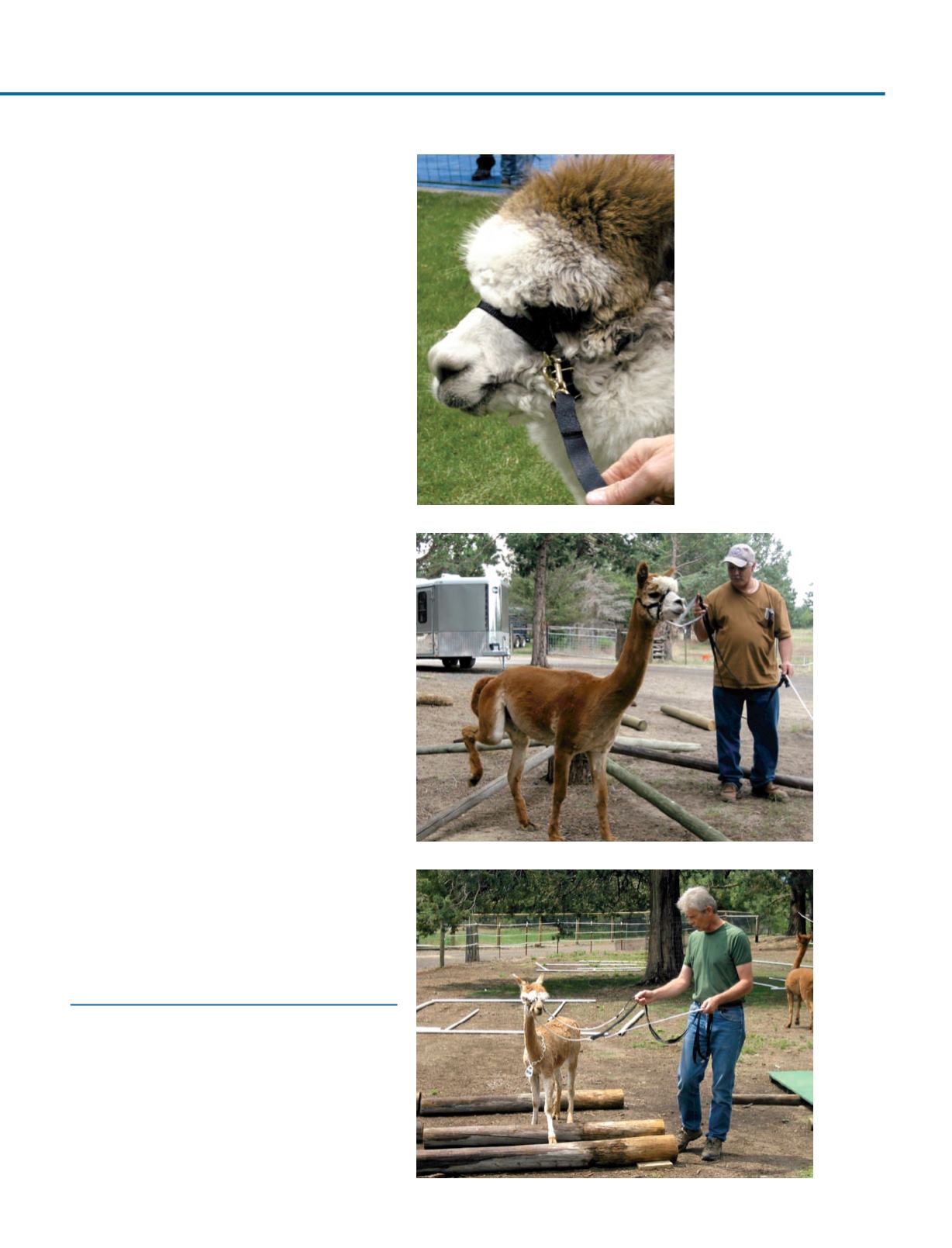
Left, the proper placement of the
lead for side leading. The lead is
on the ring that divides the upper
and lower parts of the NOSE BAND.
Many halters do not offer this
feature, and without it, this style
of leading is not an option. The snap
is placed on the leading edge of the
ring with the opening facing out.
Below, radiating poles make a nice
obstacle that helps an alpaca who
doesn’t seem to have much aware-
ness around his feet and stumbles or
drags his feet.
Bottom, this handler is enjoying a
session on our obstacle course,
using a leading technique that
involves two leads – one on each
side. In the background, you can see
many of the obstacles we use.