



 97 / 148

One of the things I continue to appreciate about
the U.S. alpaca industry is how owners help
each other learn the ropes of properly caring
for these magical creatures. As this is a relatively
new industry in the States, there’s not a lot of,
“We do it this way because that’s the way my
Granddaddy taught me.” Instead, I hear more,
“I tried that last year and this year I’m going
to try it this way.” No one has it all figured out,
therefore it’s not so intimidating for someone
with no previous livestock experience to become
an alpaca owner.
Still, as I learn to sort and grade fiber, I appre-
ciate having a connection to past generations
of fiber sorters. Regardless of the fiber, grading
and sorting is pretty cut and dried: a micron
is a micron, 3 microns equals a grade, and it’s
the fiber’s grade, color, structure, and length
which determine the highest and best use for
the yarn. Though the need for sorting alpaca fiber
prior to processing may be a new concept to U.S.
alpaca owners, fiber sorting and grading has been
a long-standing tradition not only in fiber-rich
regions across the globe, but also right here in
the United States.
In March, I felt an especially strong sense of
connection to my sorter roots when I participated
in a “refresher course” held at Harrisville Designs
in the picturesque woolen mill village of
Harrisville, New Hampshire. The Coarse Broads,
Robyn Kuhl and Carrie Hull, with the assistance
of newest Certified Sorter Heather Arenas,
conducted the refresher for eight apprentices,
as well as a full four-day sorting certification
course for 16 aspiring apprentices.
For a long weekend, we were immersed in a
rich textile history! The Harris Family established
the factory village in 1794 and it was followed by
the Colony Family’s Cheshire Mills about 1850.
The cluster of water-powered woolen mills, store-
houses, boarding houses, tenements, and homes,
most of which were built during a 50-year period
from roughly 1820-1870, helped to transform the
economy of New England. These buildings are
now owned by a public non-profit foundation,
Spring 2010
97
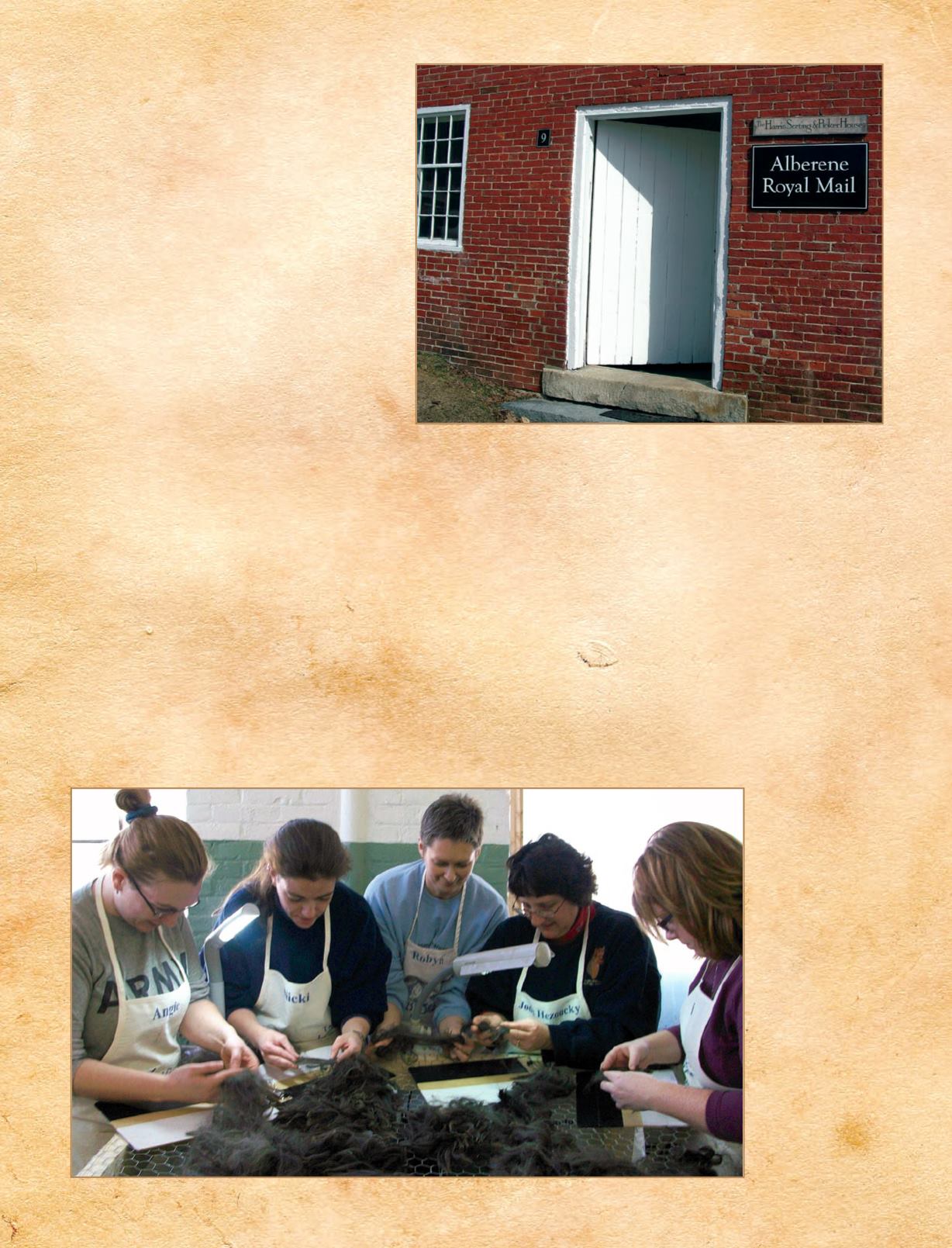
Robyn Kuhl, (center),
conducted a four-day
sorting certification
course for 16 aspiring
apprentices.
American textile
traditions are
preserved in the
historic woolen mill
village of Harrisville,
New Hampshire.
Among the buildings
in this National Land-
mark Village are the
Cheshire Mill No. 1
(opposite), and the
Sorting House (above).
Photos courtesy of Pamela Harwood