




 94 / 148

whorl. Patterns and designs made with
a wood burner added a creative touch.
I can spin very thin or bulky yarns,
depending on how much fiber slides
through my fingers. Using my home-
made drop-spindle, I can even double-
ply the yarns for variety and texture.
Over the years, my sons have left
several old bicycles out in the barn.
They would take things apart and put
them back together, so extra parts have
been scattered all around. The smallest
bicycle wheel that I found had a twelve
inch diameter; the largest wheel was
twenty six inches. What if I could
make a spinning wheel from one of
those? Research has shown me other
spinning wheels made from bike
wheels, cardboard, and string, cut from
a wooden pattern or using PVC pipes
for framework. I wanted to come up
with an original design that was simple
and functional, yet could be decorative
at the same time.
The wooden frame consists of two
upright supports made from 1
"
x 3
"
pine with
1
⁄
2
"
dowel sticks for additional
strength. Two other pieces of wood are
either the diagonal support or the base,
depending on the design of the wheel.
I began by holding the bicycle wheel in
front of me at a comfortable height for
spinning and marked a spot. I allowed
additional length for placement of
holes for the spindle and drilled the
holes. Then I cut dowel sticks for extra
support and assembled the wheel.
The smaller wheel weighs five pounds.
The larger wheel weighs around eight
pounds. Strong wood glue helps to
hold the wheels together. Each will
be painted or finished and sealed.
These wheels are hand powered
and I had to teach myself to “spin off
the tip.” Spinning goes much faster
than with a drop spindle, but slower
than with a foot powered wheel, so
I continue to experiment with building
a model that has a foot treadle. I tinker
with the drive band so that any tension
problems can be corrected with a piece
of string or a rubber band.
I’ve built five wheels as of now.
Two are completed; three more are
still in various stages of production.
One wheel is small enough to be a
child’s first spinner. One wheel can be
taken apart for use on a tabletop and
reconfigured to become a floor model.
Another can be folded for travel or
storage. How many will I build?
I don’t know. Do I want to be
rescued? Of course not.
Even though 2009’s International
Year of Natural Fiber has come to
an end, I’m having a wonderful time
and will continue on my Year of
Rediscovery. I might wander, but
sometimes, not everyone who
wanders on her journey is lost.
Paula B. Puckett, from Clermont, Georgia,
designs and builds spinning wheels. Believe
it or not, she can also spin with a rock and
a stick – but that will be the subject for another
article at a future date. She can be reached
at (770)983-2332 or
SheSails2@aol.com.94
Alpacas
Magazine
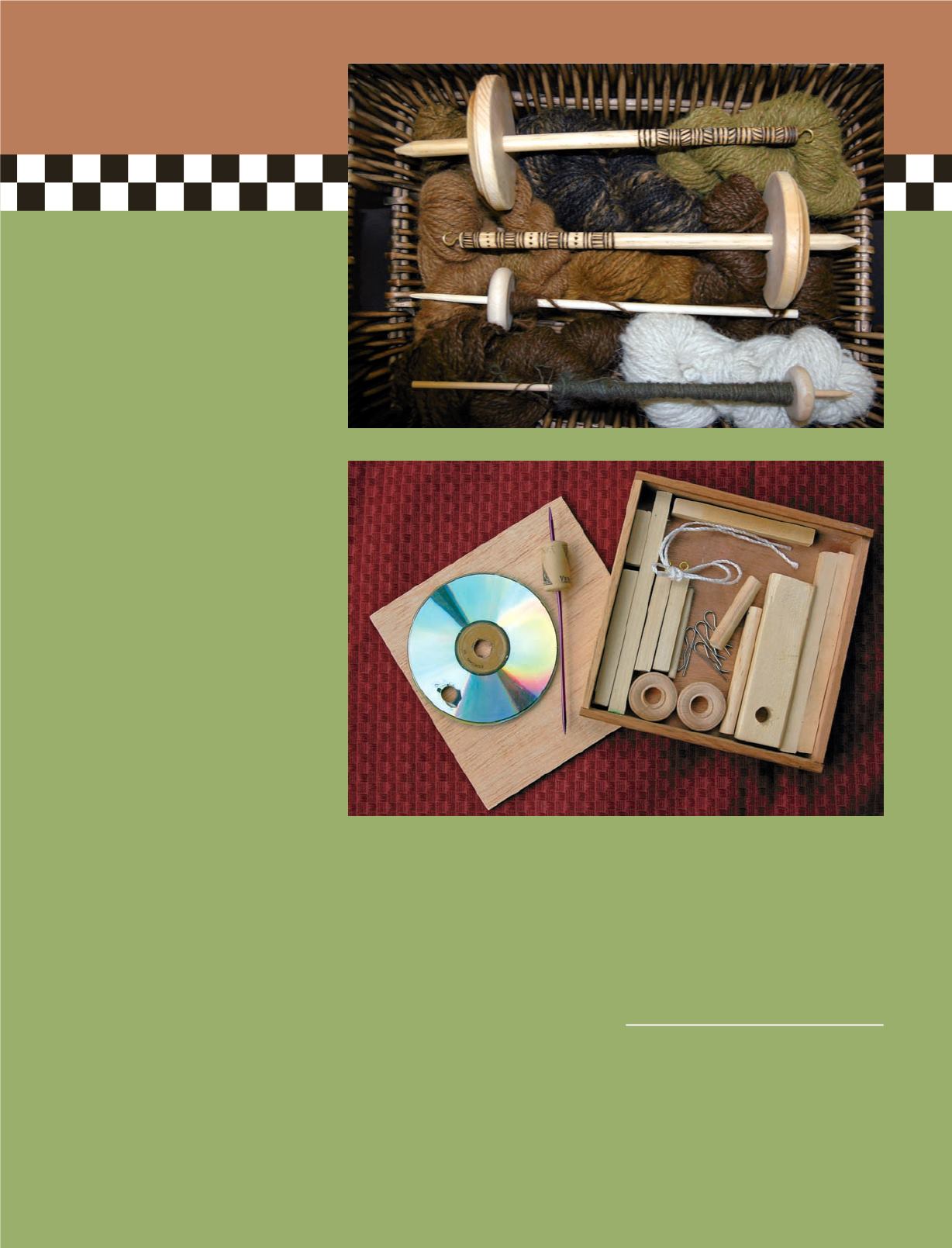
More hand-made drop
spindles, and below,
a handspinner that
breaks down to fit
in a cigar box.
Photos courtesy of Paula Puckett