




 37 / 148

Spring 2010
37
um-fine fleeces, or even slightly coarse
fleeces if the item will be worn over
other clothing, so the coarseness is
mitigated. Coarser fibers are stronger,
and suitable for clothing that will get
hard wear, such as socks or work
gloves. Yarn, felt, batts, or roving can
be made from any type of fiber.
Knowing what quality of fiber you
have to work with, and how much you
have, will help you to select appropriate
finished products. The old saying “You
cannot make a silk purse from a sow’s
ear” applies!
4. How much can you afford
to spend for processing?
Your budget will play a big part in
determining the end products that
you make from your fiber. The more
processing that is required to create
the finished product, the more it will
cost you. The least expensive option is
to have your fiber washed and carded
into batts or roving. You will get a
product that can be sold to spinners
and other handcrafters, or which you
can use for your own fiber arts projects,
at the minimum processing cost. On
the other hand, if you have your heart
set on making sweaters, be prepared to
pay a much greater amount, since the
fiber will need to be cleaned, carded,
spun, and knit to your design specifi-
cations. You will need to assess
whether you can afford the extra pro-
cessing costs, and whether it makes
financial sense. If you plan to sell the
final product but the production costs
are too high for you to cover with the
item’s sales price, it might be better to
settle for a less expensive end goal.
O
nce you know the quality and
quantity of fiber that you have
available, the type of product you want
to have it made into, and your budget
for processing, you are ready to talk to
the fiber processors. You can find fiber
processors through Internet searches,
by asking other breeders for referrals,
by checking with fiber guilds, or from
AOBA’s
Directory of Fiber Resources.
When you have identified several
mills that seem suitable, you can begin
the task of contacting the staff at each
and asking questions that will help
you to select the best partner for your
fiber processing venture.
The goals of a good fiber processor
are very similar to yours. The fiber
processor wants to create the best
quality product for the most reasonable
price. Their business success is based
on making you happy. In order for
them to do that, you need to be able
to tell them specifically what you are
looking for. If they cannot do it, they
will let you know. Good communica-
tion is the key to keeping the fiber
producer and the fiber processor on
the same page.
Your goal is to find a partner that
you can trust to produce the quality
of product that you want, with the
minimum of wasted fiber, and for the
best price. You may need to test several
partners before you find the one that
works best for you. If it is possible,
visit each mill in person. If you can’t
do that, then create a matrix where
you can list each mill, the types of
services they offer, and the pricing.
This information will be extremely
useful for you in the future, so keep
the information in a database where
you can find it again when you need
it. Minimally, you should ask the
following questions of each mill that
you are thinking of working with:
1. Does the mill have the capacity
to produce the type of product
you want?
Most mills can create rovings, sliver,
batts or yarn. A few also produce
finished products such as hats, gloves,
scarves, throws, or socks. Hardly any
are making fit goods (those items of
apparel that come in sizes), so if you
want sweaters, coats, or other goods,
you will likely need to find one
processor to create the yarn or fabric
“I know that you believe you understand what you
think I said, but I’m not sure you realize that what you
heard is not what I meant.”
Robert McCloskey, author and illustrator
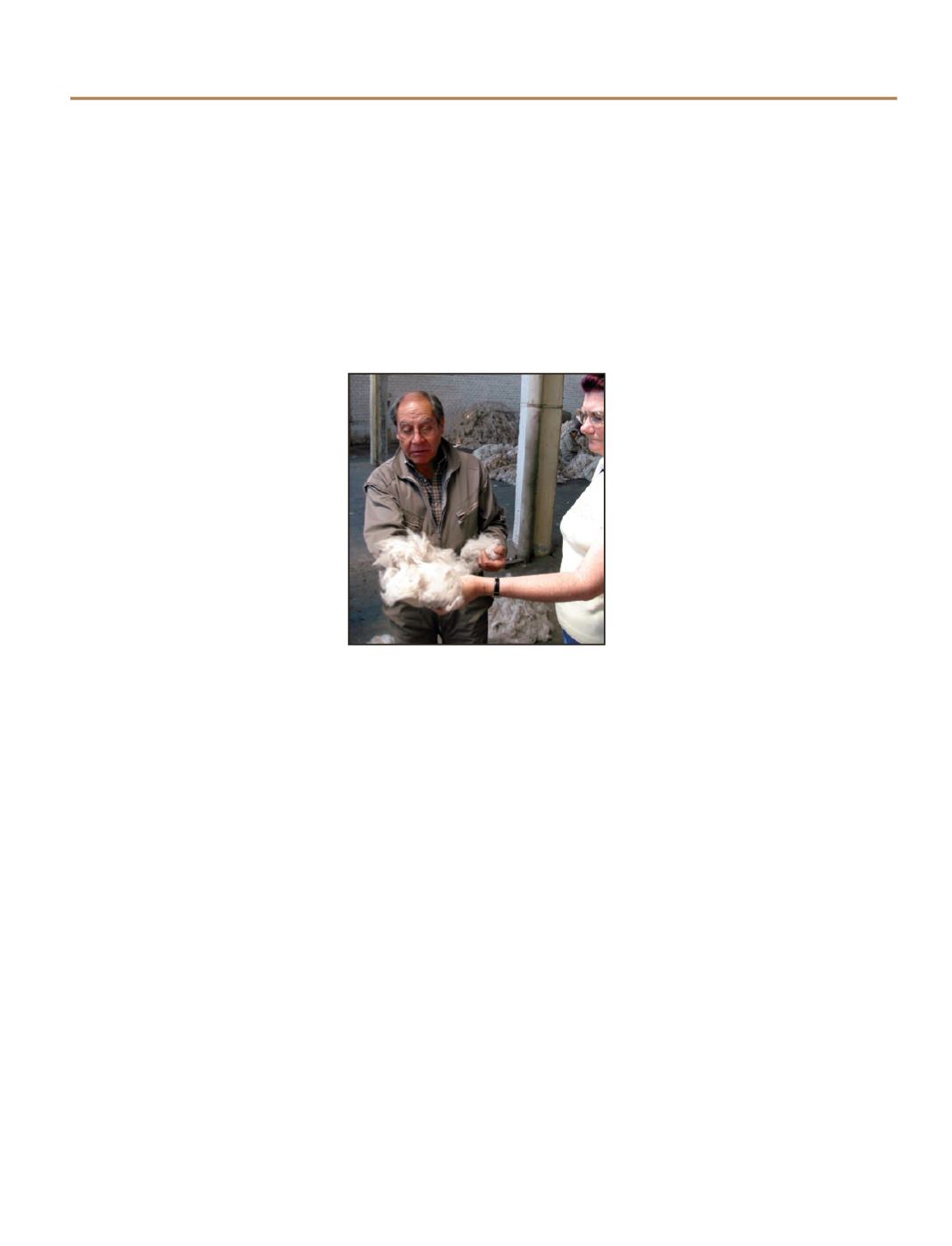
Checking out fiber quality at the mill.
Kim DeVos