



 57 / 148


Spring 2010
57
F
rom blazing bright white, delicate fawns
and browns, to bays and natural jet black,
the beautiful soft fiber of the alpaca arrays
itself in 22 distinct shades of color. In Peru, the
homeland of 80% of the world’s alpacas, the herds
are largely one color. In bygone days, Peruvian
mills paid more for white fleece than other colors,
so alpaca breeders culled their colors and bred for
white. For its ability to easily take up dye, white
fiber commanded a higher price at the mill. But
when these white Peruvian animals came to North
America, they came with color genetics locked in
their DNA. Over the course of time, these colors
resurrected and, like the leaves of autumn, they are
on spectatuclar display now throughout North
America. Important as the white became to Peru,
there is an equally important color that dominates
all the North American shades. That color is green.
Internet research occasionally reveals references
to alpaca as “the green sheep,” but the story of
their eco-friendly nature is largely untold. Raising
alpacas is indeed eco-friendly, environmentally
sound, socially conscious, and offers real potential
in pursuit of agricultural sustainability. It may
seem almost counterintuitive that wearing
something luxurious as an alpaca garment
can also be earth-friendly, but it’s true.
Processed alpaca fiber is unrivaled in its
eco-friendly nature for many reasons, but first
a look at just how softly the alpaca itself treads
on the earth. On a planet with ever-diminishing
resources, we find the alpaca to be a wise
consumer. To best understand how and why,
let’s review some alpaca history and include
a little genetics as well.
This story begins in ancient times when the
alpaca branched off from other members of the
camelid family. Some of today’s better-known
camelids are camels and llamas. These cousins are
Mother Nature’s ultimate survivors and have a
well-earned reputation working hard for humans
and asking little in return. These beasts of burden,
the camel and the llama, inhabit some of Earth’s
harshest climates.
Llamas are one of the world’s oldest forms
of domestic livestock. For centuries, this beast
Twenty-two
Natural
Colors
&
All Green!
By Jeff Merrifield
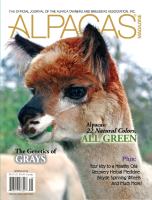
© 2009 kasseckert/stock.xchng